


Reported by journalists in South Africa: Clear steps, simple start — up to R80,000 monthly potential from R4,500

For the first time in open access: a high-precision financial technology delivering impressive results
TerionBot is an intelligent system that leverages advanced algorithms to analyze global market dynamics and optimize strategic actions.The initiative was launched with the involvement of Johann Rupert and received local recognition with reference to one of the world’s most influential economic figures — Elon M. For a long time, access to similar financial systems was limited to private investment groups and large banking institutions. Today, this opportunity has become available to ordinary citizens for the first time. In response to recent global developments, a system was introduced to help individuals explore additional income possibilities and potentially achieve results of from R15,000 per week or more. By starting with an initial amount of R4,500 and activating it through TerionBot , users may observe monthly results ranging from R80,000 to R120,000. Everyone who chooses to participate is provided with personal assistance from a dedicated manager, who will contact you by phone, explain how the system operates, and guide you through each step.
 How it works is explained by Johann R.
We have developed a high-tech solution designed to process and interpret market data in real time, allowing it to identify patterns and potential changes with a high level of accuracy. This helps users rely on automated analysis rather than manual market research. This approach allows transactions of various volumes to be handled without the need for constant personal monitoring, as analytical tasks are performed by the system itself. Thanks to access to the underlying algorithm, market signals can be identified and processed quickly, sometimes earlier than they become widely noticeable. For example, when certain conditions indicate a possible change in asset value, the system can react automatically based on predefined logic. One of the key advantages is that users are not required to follow every step of the process. The operational logic runs independently and does not require active involvement. To make this solution more accessible across Africa, the minimum entry amount has now been set at R4 500
The project can be considered 100% reliable as it has received a state license, which means that all deposits are insured by the Johannesburg Stock Exchange. Therefore, none of the participants are at risk and they can withdraw their investments and profits at any time.
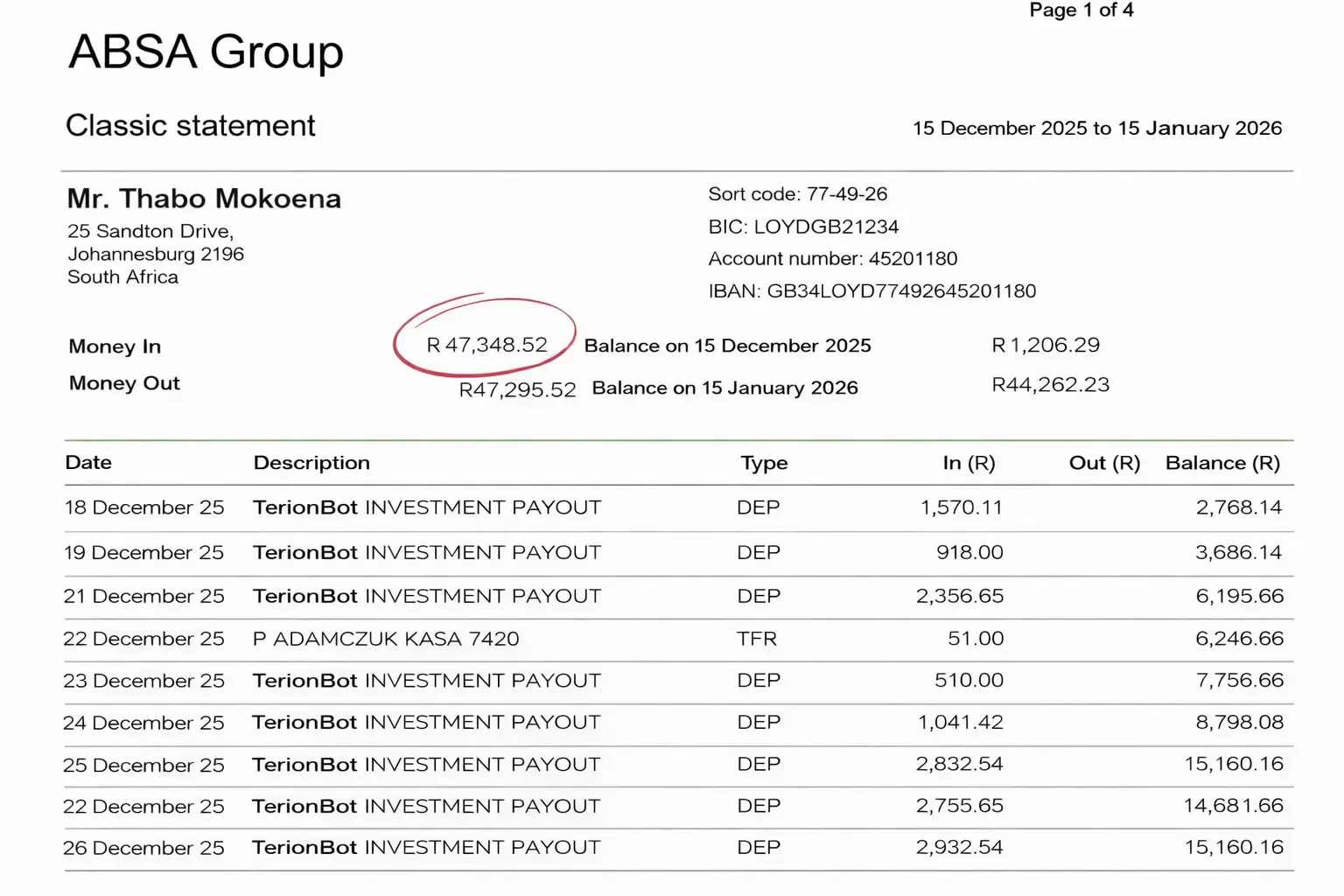
According to statistics, since public access was launched in December 2025, over 26,000 citizens have already registered in the system. On average, users receive their first results within 48 hours after activating their accounts. The platform’s internal analytics report for December shows that the average earnings of an active user in the first month range from R80,000 to R150,000 with a minimum investment of R4,500.
Most users withdraw funds to standard bank cards, and the payout schedule is chosen individually — either weekly or monthly.
Turn on your phone and wait for a call from a manager to discuss the payment schedule.In conclusion: Two strong leaders have joined forces to give every South African the opportunity, in these challenging times, to get back on their feet, learn how to operate online, and take advantage of modern digital tools that were previously available only to a select few — so they can start building their own stable future today.
Here's a brief guide on how to start earning with TerionBot :
a. Use the link provided by Johann R.
b. Wait for a call from your personal manager to confirm
registration.
c. Top up your balance. The minimum deposit to start the program
is 4,500 South African rand.
d. Control your profits with a personal assistant.
5. Withdraw your income to any bank card.